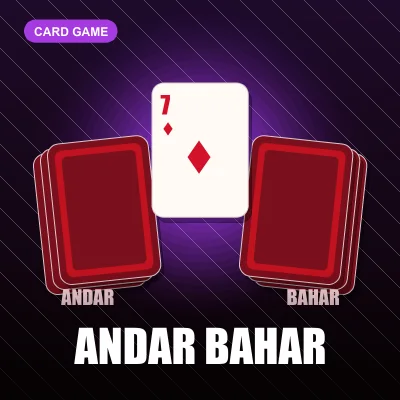
Andar Bahar
A fast Indian card game with one simple choice: will the matching card land on Andar (inside) or Bahar (outside)? How it works and what the odds mean
Style: Card game · Live dealer · Fast rounds · Table feel
- House edge Varies by provider
- Luck only
- Many players can bet on the same round. Nobody holds a hand: players only bet on Andar or Bahar
- Commonly well under a minute per round
Information only. 18+. The house edge means players lose on average over time. Real-money online gaming is restricted in India.
Overview
Andar Bahar is a traditional Indian card game in which one card is placed face up in the middle and players bet on which of two sides, Andar (inside) or Bahar (outside), will be dealt a card of the same rank first. The deal is pure chance and a round is over in seconds. It is now played as live-dealer and automated casino games with rules and payouts that differ from one provider to another.
Andar Bahar means 'inside and outside' in Hindi. A single card, often called the joker or the pointer card, is turned face up in the middle of the table. The dealer then deals cards one at a time, alternately, to two piles called Andar (inside) and Bahar (outside). The first pile to receive a card of the same rank as the middle card wins the round. Players do not hold any cards: they only bet, before the dealing starts, on which side will win. That makes it one of the simplest casino card games there is, and it is easy to follow even if you have never played a card game before.
The game is believed to have originated in India and has long been played informally at festivals and gatherings, including around Diwali, often with a regular deck and small stakes among friends. Today it is mostly known through online and live-dealer versions. On winzap.vip the casino lists Andar Bahar among its trending games and its casino games, at the time of writing. Live versions use a studio dealer and a real deck; instant versions use software to draw the cards. The exact rules, which side is dealt first and what each side pays differ between providers, so always read the rules shown inside the game.
Because the cards are shuffled and the result depends only on the order of the deck, no decision you make after placing a bet can change the result. The two sides are close to equally likely, but the casino pays slightly less than the true odds on at least one side, or takes a commission in some versions, and that is where the house edge comes from. Over many rounds the player loses on average.
Everything on this page is information only. This site (Winzap AI) does not run any game, take any bets or hold any money. Real-money online gaming is restricted in India, and the Promotion and Regulation of Online Gaming Act, 2025 prohibits online money games: see our legal guide (/guides/is-online-gambling-legal-in-india) first, and you must be 18 or older.
- Name
- Andar means 'inside' and Bahar means 'outside' in Hindi
- Origin
- A traditional card game believed to come from India; played informally for generations and now offered online
- Cards
- A standard 52-card deck. One card is placed face up in the middle and the rest are dealt alternately to Andar and Bahar
- How a round ends
- The first side to be dealt a card of the same rank as the middle card wins
- Chance the first card dealt matches
- 3 in 51, about 5.88%, because three cards of the middle card's rank remain among the other 51 cards
- On winzap.vip
- Listed among the trending games and the casino games at the time of writing; rules and paytables are set by each provider
How to play Andar Bahar
- 1Open the table and read the rules panel first: it shows the payouts, any commission, which side is dealt first and the minimum and maximum bets.
- 2Choose your chip value and wait for the betting window to open. A single card, the pointer or joker card, is shown face up in the middle.
- 3Place your bet on Andar (inside) or Bahar (outside). Some tables also offer side bets, such as betting on how many cards will be dealt before the match.
- 4When the betting window closes, the dealer deals one card at a time, alternately to Andar and Bahar. Which side gets the first card depends on the table or provider.
- 5Dealing continues until a card of the same rank as the middle card appears. The side that receives it is the winning side.
- 6Winning bets are paid at the odds shown in the game, and losing bets are collected. Many providers pay slightly different amounts for Andar and Bahar.
- 7A new round starts with a freshly shuffled deck, or with the deck reshuffled according to that provider's procedure. Earlier rounds do not change the next one.
Rules
- A standard 52-card deck is used. A single card is placed face up in the middle and its rank (for example a 7) is the rank both sides are trying to match.
- Bets are placed before dealing begins. Players bet on Andar (inside), Bahar (outside) or an available side bet; no player receives a hand.
- The dealer deals alternately to Andar and Bahar. The first side dealt a card of the same rank as the middle card wins the round.
- Which side is dealt first, whether the first-dealt card matters specially and how many cards can be dealt are set by the provider or the house rules.
- Payouts and any commission differ between providers. In some versions Andar and Bahar pay different amounts, so a winning bet on one side may return less than on the other.
- Side bets (for example on the number of cards dealt) have their own paytables and usually a higher house edge than the main bet.
- Always read the rules inside the game before betting: this page describes the general format only.
Tips for playing sensibly
Read the rules panel before betting. Which side is dealt first and what each side pays are the two details that matter most, and they change from table to table.
The side that is dealt first wins slightly more than half of the rounds, but that small advantage is usually reflected in the payouts, so it does not give the player an edge.
Do not look for patterns in the history of previous rounds. Each round is dealt from a shuffled deck and past results do not predict the next one.
Treat side bets with caution. A large payout on a rare outcome normally carries a higher house edge than the main bet.
Because rounds are so quick, spending adds up fast. Set a time limit and a money limit before you start, and only use money you can afford to lose.
Never raise your bets to win back losses. If gambling stops being fun, stop and talk to someone.
Common myths
Myth After several rounds of Bahar, Andar is due to win.
Truth Every round is dealt from a freshly shuffled deck, so the earlier results have no effect. Expecting a correction is the gambler's fallacy.
Myth Andar Bahar is a fair 50-50 game, so you break even.
Truth The two sides are close to equally likely, but the payouts or commission are set so that the house keeps an edge. Over many rounds the player loses on average.
Myth A betting system, such as doubling after every loss, will guarantee a win.
Truth Changing the size of bets does not change the odds of any single round. Doubling after losses just increases the risk of a very large loss.
Variants
Live-dealer Andar Bahar
A studio dealer deals real cards on camera while players bet from their screens. Rules, payouts and side bets are set by the provider.
Instant (RNG) Andar Bahar
Software draws the cards, so rounds can be even faster. It is the same two-side game with no dealer.
Home game with friends
Played with a regular deck at festivals such as Diwali, usually for small stakes or none. House rules, such as which side is dealt first, are agreed by the group beforehand.
Glossary
- Andar
- Hindi for 'inside'. One of the two sides you can bet on.
- Bahar
- Hindi for 'outside'. The other side you can bet on.
- Joker card / pointer card
- The single card turned face up in the middle. Its rank is the one both sides are trying to match.
- Match
- A dealt card with the same rank as the middle card. The first match decides the round.
- Side bet
- An extra bet offered at some tables, for example on how many cards will be dealt. It has its own paytable.
- Commission
- A percentage some versions take from winnings on one side, which lowers the payout.
- House edge
- The average share of each stake the casino keeps over many rounds. It is built into the payouts.
- RNG
- Random number generator. Software that decides the cards in automated, non-live versions.
Andar Bahar FAQ
What is Andar Bahar?
It is a quick Indian card game. One card is placed face up in the middle, and players bet on whether Andar (inside) or Bahar (outside) will be dealt a card of the same rank first. Cards are dealt alternately to the two sides until a match appears.
Is Andar Bahar a game of luck or skill?
It is luck only. Once your bet is placed you make no further decisions, and the result depends on the order of a shuffled deck. No betting pattern or earlier result changes the odds.
Which side is better, Andar or Bahar?
Neither side is a sure thing. The side that is dealt the first card wins a little more than half of the rounds, but providers adjust payouts or commission to account for that, so the house keeps an edge either way. Which side is dealt first depends on the table, so check the rules.
What is the house edge in Andar Bahar?
It varies by provider because the payouts, any commission and the side bets are all set by the game. This page does not give a single figure. The paytable shown inside the game is the place to check, and over time the player loses on average.
Is real-money Andar Bahar legal in India?
Playing for money is gambling, which is restricted across India, and the Promotion and Regulation of Online Gaming Act, 2025 prohibits online money games. Playing for no stakes with friends is different. This site is information only and is not legal advice: check the law where you live.
Keep learning
More games explained
 Card games
Teen Patti
India's favourite three-card game: how it is played, the hand rankings, the odds and how the live versions work
Rules & odds Table games
Roulette
A spinning wheel, a ball and a table of bets: the rules of roulette, how the payouts work and why single-zero and double-zero wheels differ
Rules & odds Table games
Blackjack
Beat the dealer's hand without going over 21: the rules, the payouts and why table rules and your decisions change the house edge
Rules & odds Table games
Baccarat
A simple three-way bet: Player, Banker or Tie. How the hands are dealt, why the Banker bet carries a commission and how the odds compare
Rules & odds
Related to winzap.vip
Winzap AI is a companion information site of winzap.vip, the Winzap brand website. We explain the games; the platform itself, its rules, limits and bonuses are on winzap.vip. Winzap AI does not offer games, take bets or hold money. 18+ only; real-money online gaming is restricted in India, see our legal guide.