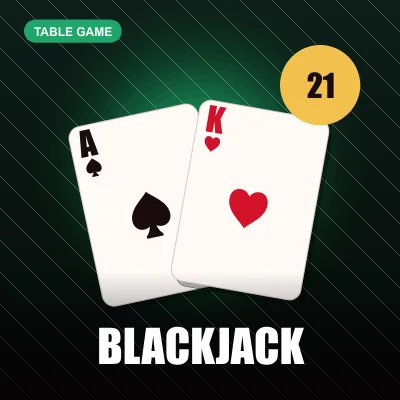
Blackjack
Beat the dealer's hand without going over 21: the rules, the payouts and why table rules and your decisions change the house edge
Style: Card game · Live dealer · Strategy · Table feel
- House edge 0.5%
- Skill and luck
- Several players at a table, each playing alone against the dealer
- A hand commonly takes about a minute or less, longer at a busy live table
Information only. 18+. The house edge means players lose on average over time. Real-money online gaming is restricted in India.
Overview
Blackjack is a casino card game in which each player tries to get a hand closer to 21 than the dealer's without going over. It is one of the few table games where your decisions change the odds: with perfect basic strategy under common rules the house edge is roughly 0.5%, but it is much higher for casual play and for tables that pay 6 to 5 on a blackjack. The house still has an edge on average.
In blackjack you play against the dealer, not against other players at the table. Each player is dealt two cards face up, the dealer gets one card face up and one face down, and every player decides what to do with their own hand. The goal is to have a hand total higher than the dealer's without going over 21. Number cards count at face value, face cards (J, Q, K) count as 10 and an ace counts as 1 or 11, whichever suits the hand better. A two-card hand of an ace and a ten-value card is called a blackjack, or a natural, and it is the best hand.
Unlike roulette or most slots, blackjack involves decisions that matter. You choose whether to take another card (hit), stay with your total (stand), double your bet for one more card (double down) or split a pair into two hands. There is a published best choice for each combination of your hand and the dealer's up card, called basic strategy. Played perfectly under common rules, the house edge is roughly 0.5%. Players who guess or follow hunches lose much more on average. The edge also depends on the table rules, such as whether a blackjack pays 3 to 2 or 6 to 5, the number of decks, and whether the dealer hits or stands on soft 17.
On winzap.vip, at the time of writing, the casino lists Blackjack among its table games and live dealer games. Online, you can find automated versions that use a random number generator and live-dealer versions where a real dealer deals real cards on camera. The rules and payouts are set by each provider and shown inside the game, so read them before you play.
Everything on this page is information only. This site (Winzap AI) does not run any game, take any bets or hold any money. Real-money online gaming is restricted in India, and the Promotion and Regulation of Online Gaming Act, 2025 prohibits online money games: see our legal guide (/guides/is-online-gambling-legal-in-india) first, and you must be 18 or older.
- Goal
- Get a hand total closer to 21 than the dealer's without going over (busting)
- Card values
- Cards 2 to 10 count at face value, J, Q and K count as 10, and an ace counts as 1 or 11
- Blackjack
- An ace plus a ten-value card as the first two cards. Usually pays 3 to 2, though some tables pay only 6 to 5
- House edge
- Roughly 0.5% with perfect basic strategy under common rules; varies with the table rules
- Decisions available
- Hit, stand, double down, split and, at some tables, insurance or surrender
- On winzap.vip
- Blackjack is listed in the casino and live dealer games at the time of writing; the rules are set by each provider
How to play Blackjack
- 1Open the table and read the rules: the number of decks, what a blackjack pays (3 to 2 or 6 to 5), whether the dealer hits or stands on soft 17, and the table limits.
- 2Place your bet before the cards are dealt, using the chip values offered at the table.
- 3You and the dealer are dealt cards. You get two cards face up. The dealer shows one card face up (the up card) and one face down.
- 4If you have a blackjack (an ace and a ten-value card) you are usually paid 3 to 2 unless the dealer also has a blackjack, in which case the hand is a push.
- 5Otherwise, decide what to do with your hand: hit (take another card), stand (keep your total), double down (double the bet, take one card only) or split (turn a pair into two hands with a second bet).
- 6If your total goes over 21 you bust and lose the bet immediately, whatever the dealer holds.
- 7When all players have finished, the dealer reveals the hidden card and draws according to fixed rules, usually standing on 17 or more.
- 8If the dealer busts, every player still in the hand is paid 1 to 1. Otherwise a higher total beats the dealer and is paid 1 to 1, an equal total is a push and a lower total loses.
Rules
- Hand values: cards 2 to 10 count at face value, J, Q and K count as 10 and an ace counts as 1 or 11. A hand with an ace counted as 11 is called soft; if counting it as 11 would bust the hand, the ace counts as 1.
- A blackjack (an ace plus a ten-value card as the first two cards) beats any other 21. It is usually paid 3 to 2; some tables pay only 6 to 5, which makes the game noticeably worse for the player.
- The dealer must follow fixed rules for drawing. Typically the dealer draws on 16 or less and stands on 17 or more, with the rule for a soft 17 (an ace counted as 11 plus a 6) varying by table.
- Doubling down means doubling your bet in exchange for exactly one more card. Splitting is allowed on pairs, with a second bet equal to the first. Rules about what you may double or split, and how many times, vary by table.
- Insurance may be offered when the dealer's up card is an ace. It is a separate side bet that pays 2 to 1 if the dealer has a blackjack, and it is generally a poor bet in the long run.
- Surrender, where offered, lets you give up half your bet instead of playing the hand. Not every table offers it.
- Each provider sets its own rules and limits, so always read the rules shown in the game.
Bets, payouts & house edge
| Bet | Pays | House edge | Notes |
|---|---|---|---|
| Blackjack (natural) | 3 to 2 (6 to 5 at some tables) | Included in the table's overall edge | A 6 to 5 payout makes the game noticeably worse for the player than 3 to 2 |
| Winning hand | 1 to 1 | Overall about 0.5% with perfect basic strategy under common rules | A push (equal totals) returns the bet |
| Insurance | 2 to 1 | Generally a poor bet in the long run | Only offered when the dealer's up card is an ace; wins only if the dealer has a blackjack |
Payouts, commissions and side bets differ between providers and casinos. Always read the rules shown at the table or in the game before anything else. Playing among friends has no house, so none of this applies there.
How these numbers are worked out
The payouts above are the usual ones, but the exact rules and payouts vary by table and provider. The overall house edge of roughly 0.5% applies only to a player using perfect basic strategy under common rules; casual play, 6 to 5 blackjack payouts, a dealer who hits soft 17 and similar rules raise the edge. Always check the rules inside the game.
Tips for playing sensibly
Read the table rules before you sit down. A blackjack that pays 6 to 5 instead of 3 to 2 raises the house edge by more than a percentage point, which is more than basic strategy can win back.
Learn basic strategy. It is a published set of the mathematically best decisions for every hand against every dealer up card, and following it is what brings the edge down to roughly 0.5%. Rely on a printed chart rather than hunches.
Treat insurance as a separate bet, and generally a poor one. It is a side bet that the dealer has a blackjack, and it carries a higher edge than the main game.
Do not change how you play because of recent hands. The cards are shuffled and earlier hands do not make the next ones 'due' to be good or bad.
Even with perfect play, the house still has an edge, so you lose on average. Set a time limit and a money limit before you start and only use money you can afford to lose.
Never raise your bets to win back losses. If gambling stops being fun, stop and talk to someone.
Common myths
Myth After a run of losing hands, a win is due.
Truth Each hand is dealt from shuffled cards and has no memory of earlier ones. Expecting a correction is the gambler's fallacy.
Myth You should always take insurance when the dealer shows an ace.
Truth Insurance is a separate side bet that pays 2 to 1. In the long run it is generally a losing bet, and basic strategy does not recommend it.
Myth If you play perfect basic strategy, you beat the casino.
Truth Perfect basic strategy reduces the house edge to roughly 0.5% under common rules, but the house still has an edge, so the player loses on average over time.
Variants
Classic (RNG) blackjack
An automated version in which software deals the cards. Rules such as the number of decks and the blackjack payout are set by the provider.
Live-dealer blackjack
A studio dealer deals real cards to a table of players on camera. Seat limits and rules are set by the provider.
Multi-hand blackjack
Lets one player play several hands at once against the dealer's one hand.
Blackjack with side bets
Offers extra bets such as insurance or side bets on the first cards dealt. These usually carry a higher house edge than the main game.
Glossary
- Hit
- To take another card.
- Stand
- To keep your current total and take no more cards.
- Bust
- To go over 21. A busted hand loses immediately.
- Double down
- To double your bet in exchange for exactly one more card.
- Split
- To turn a pair into two separate hands, each with its own bet.
- Soft hand
- A hand with an ace counted as 11, such as ace and 6 (soft 17). It cannot bust with one more card.
- Push
- A tie with the dealer. The bet is returned.
- Basic strategy
- The published best play for each hand and dealer up card. It lowers the house edge as far as it can go.
Blackjack FAQ
What is the aim in blackjack?
To have a hand total closer to 21 than the dealer's, without going over 21. You play against the dealer only, not against the other players at the table.
What is the house edge in blackjack?
Roughly 0.5% with perfect basic strategy under common rules, which is among the lowest of the casino table games. It is higher for casual play and for tables with tough rules such as 6 to 5 blackjack payouts. Over time the player still loses on average.
Is blackjack a game of luck or skill?
Both. The cards are random, but the decisions you make (hit, stand, double, split) change your expected result, and there is a mathematically best play for most hands. Perfect play reduces the house edge but does not remove it.
What is the difference between 3 to 2 and 6 to 5 blackjack?
On a ₹1,000 bet, a 3 to 2 blackjack pays ₹1,500 and a 6 to 5 blackjack pays ₹1,200. The lower payout raises the house edge by more than a percentage point, so it is worth checking before you play.
Is real-money blackjack legal in India?
Playing for money is gambling, which is restricted across India, and the Promotion and Regulation of Online Gaming Act, 2025 prohibits online money games. This site is information only and is not legal advice: check the law where you live.
Keep learning
More games explained
 Card games
Teen Patti
India's favourite three-card game: how it is played, the hand rankings, the odds and how the live versions work
Rules & odds Card games
Andar Bahar
A fast Indian card game with one simple choice: will the matching card land on Andar (inside) or Bahar (outside)? How it works and what the odds mean
Rules & odds Table games
Roulette
A spinning wheel, a ball and a table of bets: the rules of roulette, how the payouts work and why single-zero and double-zero wheels differ
Rules & odds Table games
Baccarat
A simple three-way bet: Player, Banker or Tie. How the hands are dealt, why the Banker bet carries a commission and how the odds compare
Rules & odds
Related to winzap.vip
Winzap AI is a companion information site of winzap.vip, the Winzap brand website. We explain the games; the platform itself, its rules, limits and bonuses are on winzap.vip. Winzap AI does not offer games, take bets or hold money. 18+ only; real-money online gaming is restricted in India, see our legal guide.